What technology will change the future aquaculture?
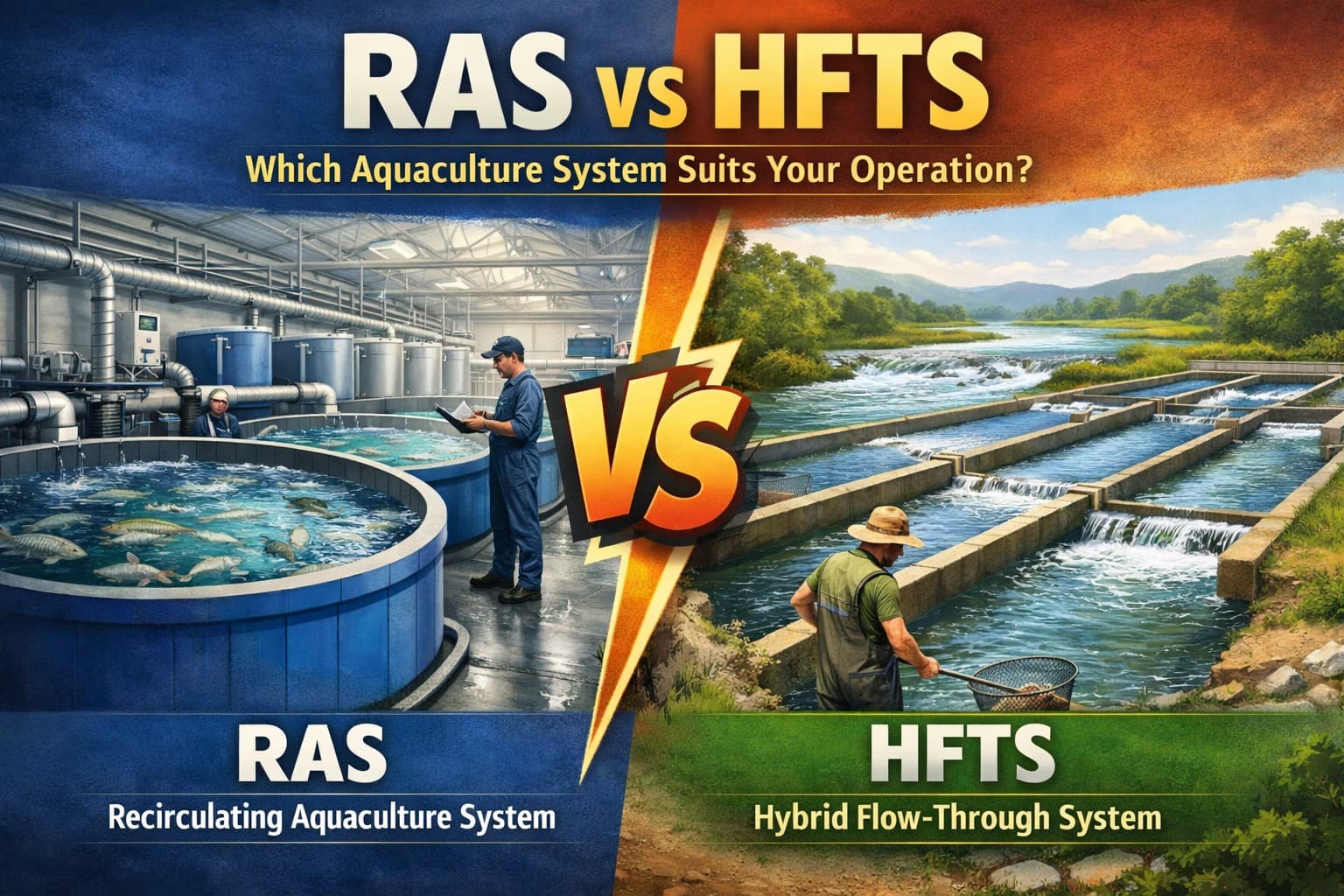
Choosing the right production technology is one of the most critical decisions in any aquaculture project. Among modern intensive systems, Recirculating Aquaculture Systems (RAS) and Hybrid Flow-Through Systems (HFTS) are often compared — and frequently misunderstood.
Both approaches can deliver high productivity, biosecurity, and predictable output. However, they differ significantly in capital cost, operating complexity, energy demand, and risk profile. This article explains how RAS and HFTS work, where each system excels, and how to choose the right one for your specific operation.
What Is a RAS (Recirculating Aquaculture System)?
A RAS is a fully controlled, closed-loop system where 90–99% of the water is continuously treated and reused.
Core Characteristics of RAS
- Mechanical filtration (drum or screen filters)
- Biological filtration (nitrification)
- Disinfection (UV / ozone)
- Oxygenation and CO₂ stripping
- Minimal water exchange (typically 1–10% per day)
- High reliance on pumps, blowers, and automation
Key Advantages of RAS
- Maximum biosecurity and disease control
- Precise control of water parameters
- Very low water consumption
- Suitable for urban, indoor, or land-limited locations
- Enables year-round production independent of climate
Key Limitations of RAS
- High CAPEX per ton of production
- High energy consumption
- Complex operation and maintenance
- Sensitive to design or operational errors
- Requires highly trained staff
RAS is often chosen for high-value species, locations with strict environmental regulations, or projects requiring absolute production control.
What Is an HFTS (Hybrid Flow-Through System)?
An HFTS combines elements of flow-through systems and RAS, using partial water exchange while still applying advanced filtration and reuse technologies.
Core Characteristics of HFTS
- Continuous or semi-continuous inflow of fresh water
- Partial recirculation (typically 50–80%)
- Mechanical and biological filtration
- Lower system pressure and energy demand
- Strong integration with natural or semi-natural water bodies
Key Advantages of HFTS
- Significantly lower CAPEX than RAS
- Reduced energy consumption
- Higher biological stability
- Greater tolerance to operational fluctuations
- Simpler system architecture
- Lower operational risk
Key Limitations of HFTS
- Requires access to a reliable water source
- Slightly higher water use than RAS
- Less suitable for fully indoor or urban sites
- Regulatory approval may depend on discharge rules
HFTS is particularly effective for medium to large-scale farms, warm-water species, and regions where clean intake water is available.
RAS vs HFTS: Side-by-Side Comparison
| Parameter | RAS | HFTS |
|---|---|---|
| Water reuse | 90–99% | 50–80% |
| CAPEX | Very high | Medium |
| Energy demand | High | Medium–low |
| Operational complexity | Very high | Moderate |
| Biosecurity | Maximum | High |
| Biological stability | Sensitive | Robust |
| Scalability | Technically complex | More flexible |
| Failure tolerance | Low | Higher |
| Best use case | High-value, controlled environments | Commercial scale, cost-efficient production |
Which System Is Right for Your Project?
The correct choice depends on biology, economics, geography, and risk tolerance, not on trends or marketing claims.
RAS Is Typically Better If:
- Water availability is extremely limited
- Biosecurity is the top priority
- You operate indoors or in urban areas
- Target species has very high market value
- Energy costs are predictable and manageable
- You have access to experienced technical staff
HFTS Is Typically Better If:
- Clean intake water is available
- You aim for commercial-scale production
- Energy efficiency is a priority
- You want lower CAPEX per ton
- You need higher system resilience
- The farm is located near natural water bodies or coastal areas
A Strategic Perspective: Technology Is Not the Goal
One of the most common mistakes in aquaculture development is choosing a technology before defining the business model.
At the engineering level, both RAS and HFTS can work. At the business level, only one will usually make economic sense.
Successful projects start with:
- Species biology and growth curves
- Local energy and water costs
- Market price volatility
- Regulatory environment
- Long-term operational capacity
Technology must follow strategy — not the other way around.
Final Thoughts
There is no universally “better” system between RAS and HFTS.
There is only a better-matched system for a specific site, species, and investment logic.
A well-designed HFTS can outperform a poorly designed RAS — and vice versa. The difference lies in engineering depth, biological understanding, and realistic financial modeling.
If you are evaluating RAS or HFTS for your operation, the decision should always be grounded in site-specific feasibility analysis, not generic comparisons.