Proper water circulation in fish ponds is critical for their functioning.
Aeration is an important condition for effective management and successful production
Photosynthesis of microalgae (phytoplankton) is the main source of oxygen in fish ponds. Microalgae often supply an excess of oxygen during the day, while at night, through the “breathing” of algae, bottom sediments, fish and/or shrimp, the oxygen supply may decrease. Therefore, the fish farmer knows that maintaining the necessary, adequate level of dissolved oxygen (DO) aeration in the water increases the safety and productivity of fish and shrimp.
Many shrimp farmers also provide aeration for several hours during the day to maintain adequate oxygenation of the mud and bottom water layers. An important issue in many pond aquaculture countries is the cost of electricity to provide mechanical aeration. Ensuring the circulation of water in ponds during the daytime is an effective strategy for enriching pond water with oxygen produced by microalgae during the process of photosynthesis, and can significantly reduce the costs of additional aeration during the night.
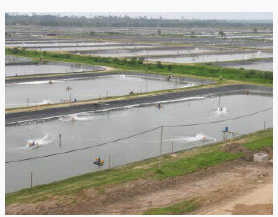
The basic principle, in addition to water circulation, is the proper mixing of oxygenated surface water layers with oxygen-depleted bottom water, which increases the total oxygen reserves in ponds. The availability of oxygen in the deep layers of water (bottom) accelerates the degradation (destruction) of organic pollutants (residues) contained in the soil of ponds, preventing the accumulation of potentially poisonous (toxic), such as those containing reduced components, organic substances in the bottom layers of water, in particular in deep ponds and ponds with temperature stratification (the presence of water layers with significantly different temperature characteristics). Circulation is effective during the time when the peak of photosynthetic activity is observed, when the surface layers of the water are supersaturated with oxygen. The basic principles and benefits of water circulation in fish and shrimp ponds are discussed in this article.
Water stratification in ponds
Water stratification is usually observed in ponds with high dams or created in ravines, cliffs, etc. The stratification of pond waters occurs because the greenish surface water (rich in phytoplankton) absorbs sunlight and heats up during the day, while the light-deprived bottom layers of water remain cold. Warm surface waters are lighter (less dense) than cold bottom waters (more dense). Since the difference in temperature, and therefore in density, is pronounced, a powerful physical stratification (stratification) is established. Anyone can actually experience this temperature/physical stratification when slowly sinking into a pond: your stomach will feel warm and your feet will feel cold. This physical stratification can only be broken by a powerful force such as mechanical aeration or strong wind. In winter, when the temperature of the surface water decreases significantly and gradually reaches the same or nearly the same temperature as the bottom water, the physical/temperature stratification is minimized or destroyed (broken). Water stratification also has a chemical nature. The presence of sunlight leads to the concentration of phytoplankton in the uppermost layers of pond water. As a result of photosynthesis occurring in phytoplankton during the daytime, surface waters are enriched with oxygen, their acidity (pH) increases, and the level of carbon dioxide decreases compared to bottom waters. Microalgae also extract ammonia (NH3 / NH4 +) and other nutrients from the water to support the process of photosynthesis and growth. Bottom waters and pond soils usually contain reduced amounts of oxygen and accumulate toxic components such as ammonia, nitrites, methane, hydrogen sulfide, and other reduced (those formed in the process of decay of organic matter) substances formed in the process of anaerobic decomposition of organic matter (mainly dead algae, fish and shrimp feces, undigested food, leaves, and decaying microbial biomass (deteriorates). Thus, photosynthesis of phytoplankton in the surface layers of water and decomposition of organic substances in the bottom layers increase the chemical stratification of the water in the pond (Fig. 1). src=”https://wp.vismar-aqua.com/wp-content/uploads/2016/06/image08.png” alt=”Fig. 1: Physical and chemical stratification of water in a pond. In the direction from the surface to the bottom, there is a decrease in light intensity, photosynthetic activity, oxygen level and water temperature. In the absence (lack) of oxygen, the bottom layers of water and pond soil become anaerobic and accumulate toxic substances (substances). Fish and shrimp try to avoid anaerobic areas in ponds. (Inscription in capital letters: light intensity, photosynthesis and oxygen: stratification of water in ponds. Orange triangle: light intensity; green triangle: photosynthesis; blue triangle: oxygen) (inscription in the first rectangle: aerobic layer of water, i.e. saturated with oxygen; inscription in the second rectangle: anaerobic layer of water, i.e. oxygen deficient)” width=”534″ height=”343″ /> The physical and chemical stratification of water in the pond. In the direction from the surface to the bottom, there is a decrease in the intensity of photosynthesis, the level of oxygen, and the bottom layers of the ponds become anaerobic and accumulate toxic substances (substances).
in letters: light intensity, photosynthesis and oxygen: stratification of water in ponds.
Orange triangle: light intensity; blue triangle: oxygen)
(inscription in the first rectangle: aerobic layer of water, i.e. saturated with oxygen; inscription in the second rectangle: anaerobic layer of water, i.e. oxygen deficient)
Concentration of phytoplankton and stratification
Phytoplankton abundance can be estimated by the water clarity with the help of the Secchi disk and used to predict the risk of oxygen deficiency in the pond often in the range of 20-60 cm. Lower water clarity means less light for deeper layers of water in a pond. There is a direct relationship between water clarity and the depth at which the amount of oxygen produced by phytoplankton through photosynthesis (P) equals the amount of oxygen absorbed by respiration (R).
In limnology (the science that studies inland water bodies), P is assumed to be equal to R at a depth 2.4 times greater than water transparency. Thus, in a pond with a transparency of 0.5 m, P should equal R at depths of about 1.2 m. Below (deeper) 1.2 m, R exceeds P and the level of oxygen content decreases sharply towards the bottom. For ponds with a water transparency of 0.2 m, R begins to exceed P at depths greater than 0.5 m. Thus, a decrease in water transparency increases the probability of a decrease in the amount of oxygen dissolved in the water (and, accordingly, in their anaerobic state). Considering this, as well as economic expediency, fish ponds should not be built too deep. However, in the case of construction of ponds in ravines or cliffs, it is almost impossible to avoid deep-water areas (more than 5-6 m deep) in the center of the dam (dam), since quite often the dam must be high to create a reservoir of a large area.
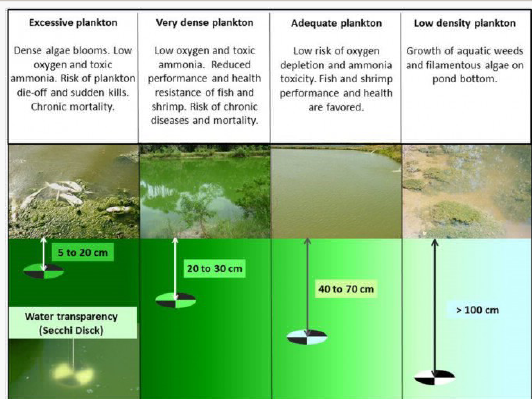
(left column: Excessive plankton. Heavy water blooms. Low oxygen and toxic ammonia. Risk of plankton kills and sudden mortality Secchi water transparency – 5-20 cm. Next bar: very abundant plankton. Deterioration of fish and invertebrate health. Secchi disk transparency – 20-30 cm.
Third column: Adequate amount of oxygen and increase – toxic ammonia. The behavior of fish and their health is normal. Transparency behind the Secchi disk – 40-70 cm.
density of plankton. Aquatic plants and filamentous algae grow on the bottom of the reservoir. The transparency of the water behind the Secchi disk is more than 100 cm.)
Depletion of oxygen reserves and toxic components in the bottom layers of water
Physical and chemical stratification is less pronounced in shallow ponds generally contribute to sufficient water circulation and mixing. Thanks to this mixing, oxygen reaches the lower layers. However, stratification is quite pronounced in deep ponds. Because deeper layers of water receive less light and wind helps to mix water only to limited depths, the oxygen level at great depths is usually zero, or even has negative values in ponds 2.5 m deep. decomposition of organic substances. This additional oxygen demand is known as the “negative redox potential” of pond soil or water. Soil and bottom layers of water often have a negative redox potential. Therefore, the bottom layers of water in deep ponds (as in ravines or cliffs) or large reservoirs are generally “inhospitable” to aquatic life and can even pose a threat to fish and shrimp due to lack of oxygen, high levels of carbon dioxide and the presence of various toxic components. Accumulated organic residues are also a shelter and a nutrient medium for the spread of pathogenic – and often conditionally pathogenic organisms. The deeper the pond, the greater the volume of toxic, oxygen-deprived water that will accumulate in its deep layers.
Risk of Sudden Overturning
A pond with anaerobic and toxic bottom waters is a time bomb. Very rapid and complete mixing of bottom and surface waters (pond “overturning”) can occur, which can cause a drop in oxygen content with a simultaneous increase in carbon dioxide and toxic compounds. High winds, large runoff volumes, and sudden temperature drops, etc., can cause a pond to suddenly “roll over” (the release of low-oxygen bottom water into the upper water layers). In the case of such a “overturning” of the pond, a sharp deterioration in the well-being of aquatic animals and a mass death of fish can be noted. In deep ponds, the level of oxygen dissolved in the water is often zero already at depths of 2.5-3.0 m. The deeper the ponds, the more rotten, anaerobic and low-quality water they contain in their deep layers. In ponds deeper than 5 m, the volume of harmful bottom water can exceed the volume of surface water of good quality (Fig. 3). This is the reason that when “overturning” occurs in deep ponds, fish or shrimp die or their welfare deteriorates, unlike animals living in shallow water.
Large channel ponds are often used for raising fish in ponds. In fact, without options, the ponds are placed in the deepest parts of the pond to keep the fish as far away from their own feces as possible. Farmers also commonly use paths (paths) built along the tops of dams to facilitate access to the ponds. However, placing the ponds in the deepest areas increases the risk of losing the entire group of fish in the pond in the event that the pond “overturns”. Fish kept in ponds have no chance to escape from an affected area of water to a less affected one as a result of an emergency and often die (Fig. 3). To reduce the risk of overturning fish and to prevent fish kills, small and medium-sized ponds (1.5-2.0 m deep) should be located above the shallow water zone, when the distance from the bottom of the pond to the bottom of the pond is assumed to be 0.5-1.0 m. In addition, the usual mixing of oxygen-enriched surface water with oxygen-poor deep water helps to ensure deep layers of water in ponds with oxygen, reducing the damage that can be caused to fish by sudden “overturning” of ponds. 3: Illustration of a pond with steep slopes. The sudden complete mixing of deep and surface waters (“overturning” of the pond) increases the likelihood of fish mortality in ponds located above the dam, since the volume of oxygen-poor and actually anaerobic deep water in such a pond significantly exceeds the level of oxygen-rich surface waters ponds located above the shallow part, in the case of a pond “overturning”. As an example, it is worth mentioning the mass death of tilapia in a 4-hectare pond due to a sudden “overturning” of a pond during a storm with precipitation. According to the analysis, the level of dissolved oxygen on the water surface near the dam was close to zero.” width=”536″ height=”200″ /> Fig. 3: Illustration of a pond with steep slopes, in which there are planters. Sudden complete mixing of deep and surface waters (overturning of the pond) increases the likelihood of a serious risk of increased fish mortality in ponds located above the deep-water part near the dam, since the volume of oxygen-poor and actually anaerobic deep water in such a pond significantly exceeds the level of oxygen-rich surface water. The risk of death of fish placed in ponds located above the shallow water part in case of “overturning” of the pond is reduced. As an example, it is worth mentioning the mass death of tilapia in a 4-hectare garden due to a sudden “overturning” of the pond during a thunderstorm with precipitation. During the extreme event (mass death of fish), according to the analysis, the level of oxygen dissolved in the water on the surface of the water near the dam due to the “overturning” of the pond was close to zero. of sudden “overturning” of the pond. In the column on the right: the depth zone (closer to the dam): increased risk of death of fish due to “overturning” of the pond. Aeration is an important condition for effective management and production. providing oxygen and its availability in the upper layers of the water column. At night, limited oxygen reserves are quickly absorbed as a result of the respiration of zooplankton, fish and/or shrimp, various microorganisms, as well as the process of oxidation of reduced components in the water and on the pond soil. To prevent oxygen deficiency, fish farmers often carry out additional aeration of ponds at night. In ponds used for shrimp farming, farmers also aerate during daylight hours to increase dissolved oxygen levels and overall improve bottom water and soil quality as shrimp use natural food organisms and consume sunken pellets (pellets) in this area.
Water circulation is an effective strategy for mixing oxygen-rich surface waters and low-oxygen (anaerobic) bottom waters (Figure 4). Surface waters are oversaturated with oxygen during the photosynthesis of microalgae during solar days. Photosynthesis, thus, is the fastest, most efficient and cost-effective way to add oxygen to pond waters. In fish ponds during the peak of photosynthesis (from 11 a.m. to 3 p.m.), the oxygen concentration in surface waters exceeds 2 mg O2/l/h. (or 2 g O2/m3/h). Photosynthesis is able to supersaturate the surface waters of ponds with oxygen much more efficiently than the most efficient microbubbles, which are created by using ceramic diffusion plates, which are used for oxygenation (saturation with oxygen) of special tanks for transporting fish (“fish trucks”). 400″>2), with a near-surface layer of water 0.6 m thick, oxygen saturation to a concentration of 2 g of oxygen per m3 per hour due to photosynthesis will equal 12 kg of oxygen per hour, which must be supplied to the pond mechanically (forced) methods. For comparison, an impeller and vertical pump aerator effectively incorporates about 1 kg of O2/hp/h. Thus, in order to incorporate the amount of oxygen that enters the water as a result of photosynthesis, it is necessary to expend (provide a supply of) 12 hp/h. mechanical aeration. In reality, much more power is required for aeration, since a mechanical aerator can incorporate oxygen into the water to the point of dissolved oxygen saturation (about 7.8 mg O2/L at 28°C at sea level in fresh water and 6.4 mg O2/ l in seawater at a salinity of 36 0/00. And saturating water with oxygen through mechanical saturation requires great effort and equally great energy expenditure, the closer you try to get to the maximum saturation levels, that is, the least effective method is oxygenation due to atmospheric oxygen with mechanical aeration.
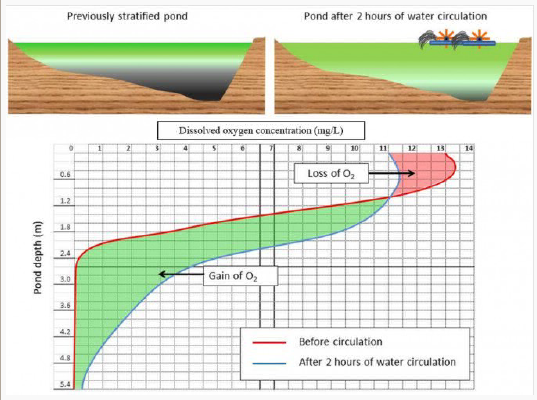
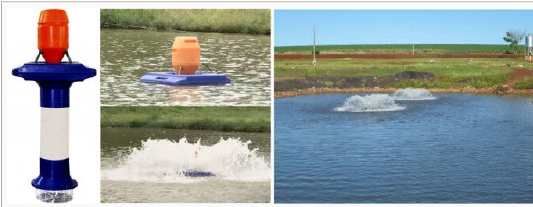
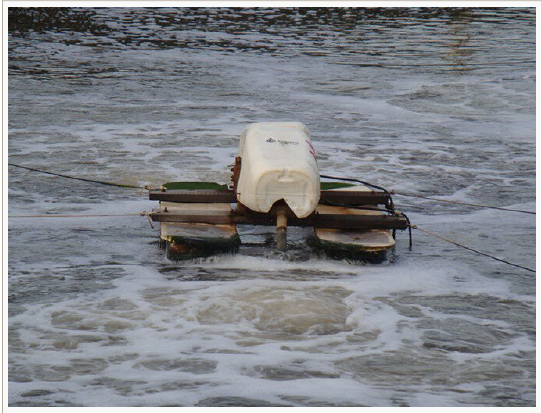
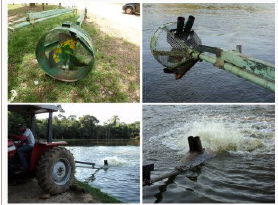
How to influence the water circulation? style=”font-weight: 400″>Surface water must be pushed down (using impellers, suction-type (jet) pumps, or specially designed water circulators, other devices) or bottom water must be lifted up (using air-lifting devices, vertical “fountain” type aerators, or other means) to improve water circulation (Fig. 5). In order to make the breaking of the stratification (destruction of the stratification) of the water column more effective, to improve the oxygen saturation of the bottom waters and to increase the oxygen reserves in the pond as a whole, water circulation should be carried out during the hours of the maximum of the photosynthesis process, when the near-surface waters are oversaturated with oxygen.
[caption id="attachment_290" align="aligncenter" width="541"]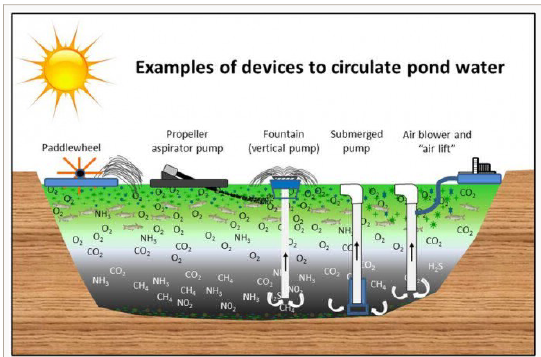 Fig. 5: Schematic representation of some devices used to improve water circulation in ponds. Some of them are used to “push” surface water down (vane aerators and jet pumps), and some are used to lift bottom water to the surface (aeration with vertical pumps or “fountains” equipped with 150-200 mm pipes, submersible pumps or devices to provide airlifting). Fig. Fernando Kubitza.
Advantages (benefits) obtained as a result of water circulation
As mentioned in the discussion above, regular water circulation breaks down the chemical and physical stratification of water in a pond, making the pond environment more homogeneous (uniform) and stable, and significantly reduces the risk of fish kills in as a result of a sudden “overturning” of the pond. Water circulation increases the total water content of the pond, reducing the time and cost of additional circulation at night. Thanks to water circulation, the productivity of microalgae (phytoplankton) and the availability of natural food (microalgae, zooplankton and benthos organisms) increases. Thanks to this, microalgae are in constant motion and are provided with nutrients that are formed as a result of the decay (decomposition into components) of organic substances in the bottom layers. In addition, water circulation appears to favor the existence of beneficial microalgae, particularly green algae, reducing the dominance of undesirable cyanobacteria (blue-green algae), often associated with adverse events for cultured aquatic animals and with some cases of fish toxicity. The usefulness of green algae for reducing vibrio infections in shrimps has also been shown. As the quality of bottom water and pond soil improves as a result of circulation, benthic organisms become more available and suitable for fish and shrimp nutrition. In ponds with good water circulation, fish and shrimp can better use the entire capacity of the pond – from the bottom to the surface – and have more opportunities to feed on natural food. Since natural food serves as a source of nutrients, the quality of water in the pond improves, farmers get better growth of hydrobionts, the feed ratio and survival rate of cultured fish and crustaceans improves.
Endnotes
In general, fish farmers subconsciously understand the benefits of circulation for fish and shrimp. But not all of them use circulation in their practical activities on a regular basis. My personal conviction and extensive experience prove that by circulating water, fish farmers can significantly improve the quality of the pond environment, productivity indicators (growth and feed ratio), health, survival rate, speed (intensity) of feeding, and, as a result, increase the yield of cultivated aquaculture objects. And I hope for a wider application of water circulation based on the fundamental principles outlined in this article. I must emphasize that most of the observations regarding water circulation are rather empirical, and few control studies actually support the benefits of circulation.
More thorough research on water circulation in ponds should be aimed at:
- a) identifying and developing the most efficient devices to ensure water circulation in ponds;
- b) development of protocols and guidelines for the use of water circulation; 400″>Acqua Imagem Services in Aquaculture
Rua Evangelina Soares de Camargo, 115
Jardim Estádio – Jundiai/SP – CEP 13203-560 Brazil
400″>fernando@acquaimagem.com.br
© 2016 The Global Aquaculture Advocate
Permanent email address on the Internet:
http://advocate.gaalliance.org/proper-water-circulation-in-aquaculture-ponds-critical/
andhttp://advocate.gaalliance.org/proper-water-circulation-in-aquaculture-ponds-part-2/