From March 14 to 18, 2016, an international team of students received practical training on the secrets of shrimp farming in Thailand. This event was made possible thanks to the organizer of this seminar, David Kawahigashi, and his partners from Vannamei 101.
The organizers of this course gave students the opportunity to observe all stages of the shrimp business in the land of smiles. Below I will try to explain the operation of the key components of this business, which is important for the country’s economy.
Since shrimp farming has been carried out in Thailand for more than 100 years, this business is quite segmented, i.e. Each key organization tries to do one thing and do it well.
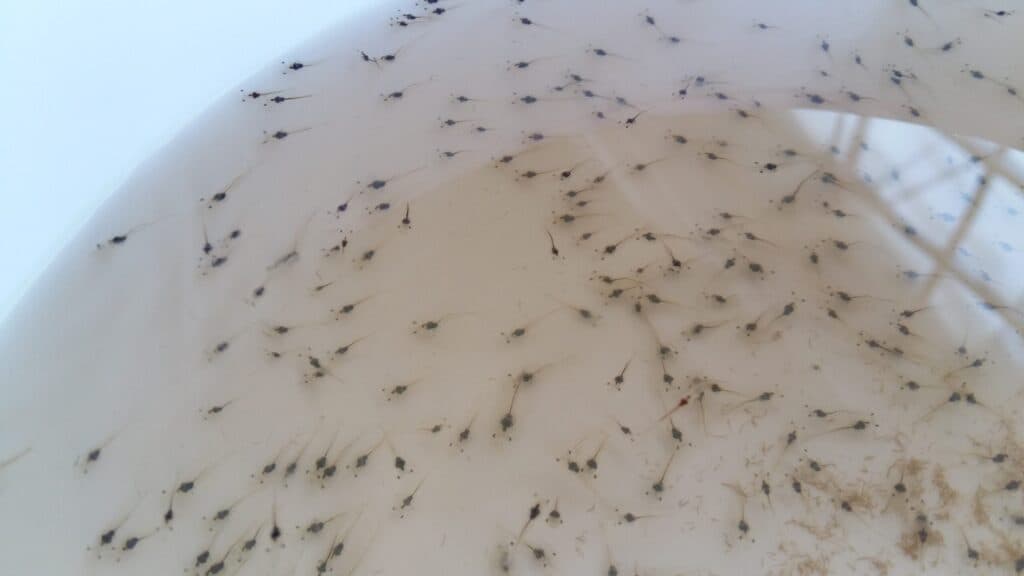
And so, the shrimp business begins with the production of fry. In order to obtain shrimp nauplii, there are a number of broodstock and multiplication centers in the country, whose task is to maintain the broodstock and regularly obtain shrimp nauplii. Shrimp naupliia is a newly hatched organism, which after 2 weeks will go through another 3 phases of development and turn into a small shrimp.

Usually such a farm contains at least 100 pairs producers who can produce about 3 million nauplii every week.
Producers at 2-3 months of age are supplied from breeding centers located in Florida and Hawaii (USA). According to local breeders, Thailand does not have its own genetic centers for the production of maternal specimens. All mothers are imported. These individuals have a special index SPF (specific pathogen free – without specific pathogens), that is, fully domesticated and selected animals that are intended for use in the program for producing offspring.
From 5-6 months of age, the breeding stock begins to be used in the breeding program. Typically, these animals are used for only 4-5 months, after which their productivity drops and they are replaced by a new batch of young individuals. From one female you can get up to 4 million nauplii over the entire breeding cycle.

Next, the resulting nauplii (the day after receiving the eggs) are sent to special farms that specialize in growing shrimp from nauplii to the postlarval stage-10 (10-day larva). The growing cycle takes about 30 days. Many farmers prefer to purchase postlarvae at 15 days of age (PL15), so the nursery can raise larger larvae.
Only after this does the grown larvae reach the farmer’s farm. But at this stage it still does not end up in the nursery pond. Savvy Thai farmers also raise them in separate pools until the age of PL-45 at a high stocking density (10 pieces per liter), and only after that they release them into nursery ponds, where after 60 days the first harvest of shrimp weighing 15-18 grams begins.

Many farmers use the principle of partial harvesting shrimp. Thus, they start making profits earlier, as well as shrimp of different sizes: 14-16 g, 18-20 g, 22-25 g, 28-30 g. The larger the shrimp, the more expensive it is. The cost of a shrimp in the size of 18-20 g at the farm is 205 Thai baht (about 6 dollars per 1 kg).

Very interesting observation that catching shrimp does not produce the owner and his workers, and the employees of the broker company that purchases the shrimp. Therefore, a farm with a productivity of 150-200 tons of shrimp per year is usually maintained by the owner and 2-3 hired workers.
Many small farmers use the following scheme: they buy larvae, feed and other components from one supplier, and sell the grown products to him. Those. The shrimp farming market in Thailand is mature and every company is trying to do what it does best. Divide and conquer – this is exactly the principle that Thai shrimp producers operate on.
The profitability of a shrimp farm is somewhere around 30%, i.e. For every kilogram of produce grown, the farmer receives about 1.8 US dollars. Shrimp farming is a highly profitable business in Thailand, so many people are showing more and more interest in it.
But it’s not that simple: like any business, the profitability of a shrimp farm depends on many factors. One of the most important factors for the success of any farm is proper management. Without proper and methodical farm management, it is impossible to achieve good results.