On September 6, a landmark event for the development of Ukrainian aquaculture took place in the premises of the State Fisheries Agency of Ukraine. On this day, the first working meeting of the group on the development of trout farming in Ukraine was held under the chairmanship of the vice-president of the Ukrainian Aquaculture Community Oleg Bozyk.
It included representatives of the State Fisheries Agency, the Institute of Fisheries of the National Academy of Sciences, the Lviv National University of Veterinary Medicine and Biotechnology named after S.Z Hzytskyi and the Ukrainian aquaculture community.
The working group was supposed to start work on the Program for the Development of Trout Farming in Ukraine. The goal of the program: to increase the production of Ukrainian trout to 10,000 tons per year within a 5-year period.
According to the Ukrainian Aquaculture Community, up to 1.5 thousand tons of trout are grown in Ukraine today.
Unfortunately, the author of this article was absent in Kyiv during this event due to a business trip. Therefore, I received all the information on the work on this project indirectly through several people who participated in this event. In this article, I want to focus on some nuances in more detail.
At the round table, the participants discussed and looked for ways to solve industry problems, such as:
- The lack of transparency in drawing up lease agreements and obtaining permits (I would like to pay special attention to charging rent and obtaining permits for special water use).
- Registration (legalization of farms), project approval of already built farms.
- Insufficiency or absence of circulation funds and initial capital.
- Lack of qualified personnel.
- Problem with access to sales markets.
- Inaccessibility of the capital market.
- Depreciation of funds and material and technical means.
- High cost of fodder, and their ways cheapening.
A lot of mass media picked up this event, but, unfortunately, the ignorance of journalists and many participants of this market led to the fact that a lot of information appeared in the mass media that does not correspond to reality.
How much trout is grown in Ukraine?
Many sources call the number up to 1,500 tons per year. Some reduce, giving a discrepancy of 1100-1400 tons of fish per year. In trying to answer these questions, I asked many people for information. But very often it is not possible to get information due to the closure of many farms. It is clear that the owners are afraid to disclose the real volume of trout farming in connection with possible abuses by the regulatory authorities.
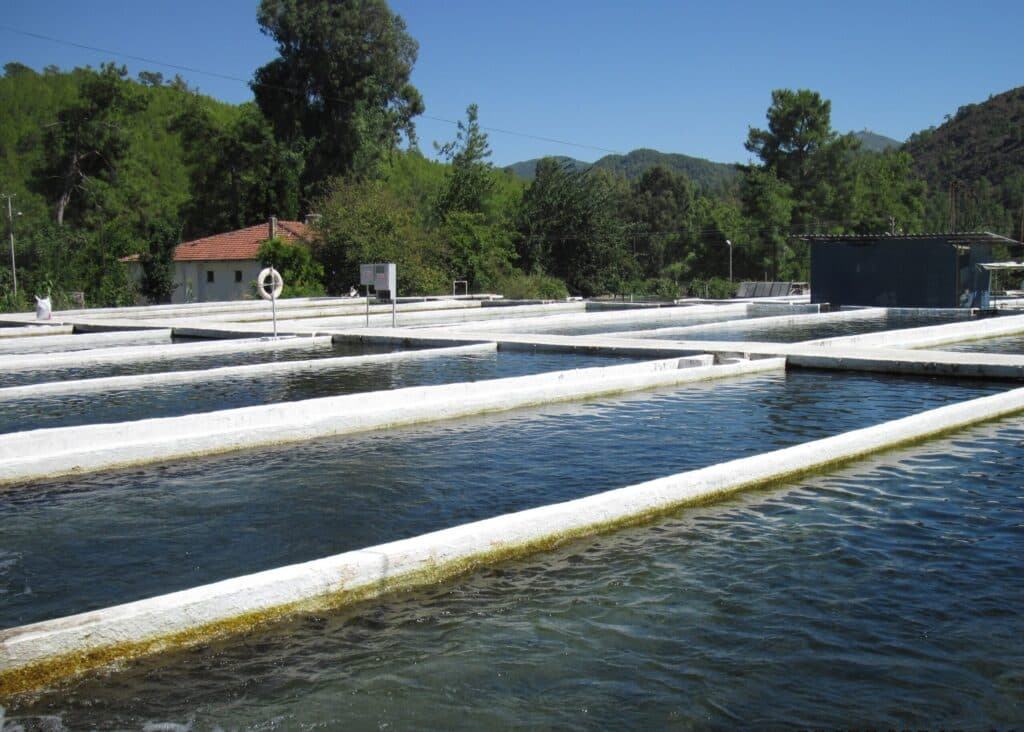
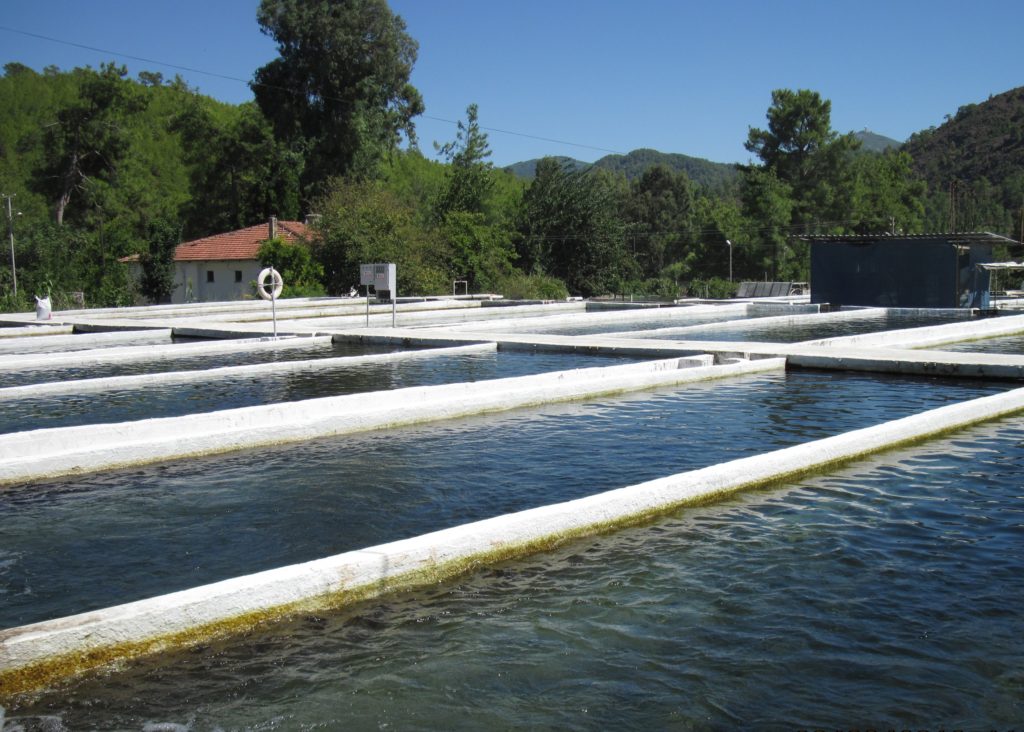
But in order to evaluate the real market of trout farming in Ukraine, let’s try to analyze this volume according to other indicators. It is known that under optimal conditions, in order to grow 1 kg of live fish, about 0.95 kg of feed is needed. This is under optimal conditions for growing trout (water temperature – 15-17C, oxygen – more than 8 ml/l), which can be created only in modern recirculation systems for growing fish (RAS), which allow you to control all vital parameters. Since trout in Ukraine is grown according to a rather primitive scheme (strait), where water is simply pumped through pools with fish, the use of feed can increase to 1.2-1.4 kg per 1 kg of fish grown.
In 2015, about 700 tons of fodder were officially imported into Ukraine, which means that only 600 tons of farmed fish were produced. Many of you will say that the rest of the fish can be grown on Boyen waste, small fish, etc. etc. Everything is possible! But when a smart farmer tried to feed with waste, he saw that the output he received was not the product he expected.
So, if we take feed by feed, the volume of trout grown in Ukraine does not exceed 600 tons of fish. Of course, there is probably a gray import of fodder, the import of which is not registered by the customs authorities. But then it is necessary to import at least 700 tons of fodder to grow another 600 tons of fish, which is insufficient to understand the overall picture. If half of the fodder is imported semi-legally or illegally, then I see the problem of fodder as one of the main problems in trout farming. As you can see, this problem is in the last place for local fish farmers.
Which body should have information about the volume of trout farming?
As we can see, the chain of questions continues and one question gives rise to another. Where is it possible to get information about the volume of cultivation of any type of fish in Ukraine? In the State Statistics Service, the State Fisheries Farm or some other controlling body?
None of the listed authorities have this information. At the very least, real volumes of cultivation. Although they should have.
Who might need this information? First of all, to the fish farmers themselves. Such statistics will make it possible to adjust the amount of cultivation between farms. With the increase in volumes, there will necessarily be specialization of farms in terms of activity: breeders, fry farms, cultivation of commercial fish, processing, transport, etc. This will attract additional investments in aquaculture and create additional jobs. In addition, it will make the market completely transparent, which will allow access to financing by credit institutions.
This information is also needed by the same credit institutions and portfolio investors who will be able to invest in the production of fish products. You should not expect manna from heaven if the producers conduct business semi-legally and grow fish on “gray” feed.
This information will also be useful to producers of fodder, equipment, and project organizations that are directly related to increasing fish productivity in farms.
Therefore, the functions of keeping statistics should be taken over by a business association that can unite all interested market participants. The registration of the Ukrainian Aquaculture Union was just in time, which, in my opinion, should make this one of its most important missions.
Where are the Ukrainian aquaculture specialists?
The staffing problem in this field is actually simply amazing: there are practically no fish farming specialists. This is to write very briefly about the current state of aquaculture education.
Unfortunately, our aquaculture facilities do not provide the necessary knowledge and skills for a person to come and do something. Basic questions (daphnia species for feeding fish fry, incubation of Artemia eggs, necessary conditions for breeding fish, etc.) are not supported by theoretical knowledge, and there are no words about practice. Very often, teachers of educational institutions are not well versed in the subject of their teaching. Free education does not prepare specialists for business, but rather cashiers in modern supermarkets and traders in spontaneous bazaars.
What to do? First, at the state level, at least, declare alarm and increased combat readiness in this field. First of all, declare 2017 the year of aquaculture. Develop action plans for the development of one or another branch of fish farming (trout farming, sturgeon farming, mariculture, malacoculture, tilapia, crayfish, etc.).
One of the most necessary is the creation of the State Aquaculture Center. It should be an educational and experimental institution, where anyone who wants to can enroll in a full-fledged education, which will give not only theoretical, but also practical skills. Of course, training should be based on a contractual basis and companies interested in training their own specialists will be able to solve the acute personnel problem. I am sure that the basic skills for a specialist can be laid in just 3-4 months of such training. After all, the center will teach only what is really needed in production, without extra subjects, the knowledge of which, as a rule, is not used in practice.
On the basis of this center, Ukrainian scientists working in the field of aquaculture will be able to conduct real research of their research. In essence, this is the creation of a centralized material and technical base for the development of domestic developments, which will have a direct impact on increasing the productivity of fisheries and farms.
How much trout does our country need?
One of the important goals of the working group on the development of trout farming is to increase the production of fish to 10,000 tons per year. These figures are based on 1,500 tons being grown and consumed now. Plus, there will be import substitution of those 3,600 tons delivered to Ukraine. And the remaining 5,000 tons will go to foreign markets.
Let’s try to deal with those 3600 imported trout. Imported trout can be conventionally divided into two types: white fish is fish grown in fresh water weighing up to 2 kg, and red fish is fish grown in the sea weighing 2 kg and above. And if you look at the volumes of imports, it is not immediately clear which trout is “red” and which is “white”. The fact is that it is white trout that is grown in Ukraine. Our climatic conditions do not allow the cultivation of red fish in our sea – it is warm in the summer. In countries where this is possible, trout raised in fresh water undergo the process of smoltification (adaptation to life in salt water) and are then released into large cages installed in the sea.
Thanks to the exclusion of countries that supply red fish, we and the leadership of Aassociation “Ukrainian seafood importers” (http://uifsa.ua/) came to the conclusion that the share of white fish in trout imports is no more than 600 tons of products in 2015.
So, currently the maximum consumption of white trout in Ukraine is about 2000 tons per year. This is according to the most rosy estimates. In reality, this figure may be 25-30% lower.
In order to close the difference in imports, you need to build 6-7 small farms of 100 tons of fish per year. This is an investment in the amount of 3.5 million Euros, which is a drop in the ocean for some big business, but a really big step for the development of modern aquaculture.
Ways to increase fish productivity
Undoubtedly, all the issues that were raised at the meeting of the working group groups are archivally important for the development of trout farming. But, unfortunately, there was no mention of the intensification of trout farming.
In this matter, it is necessary to follow the experience of Denmark, where thanks to the introduction of modern aquaculture technologies, it was possible to significantly increase the volume of fish farming in a short period of time. At the moment, Denmark is one of the leaders in Europe in the cultivation of portioned trout. Annual cultivation is 27,560 tons of this valuable fish, which is 25 times more than in our country, the largest in terms of territory in Europe.
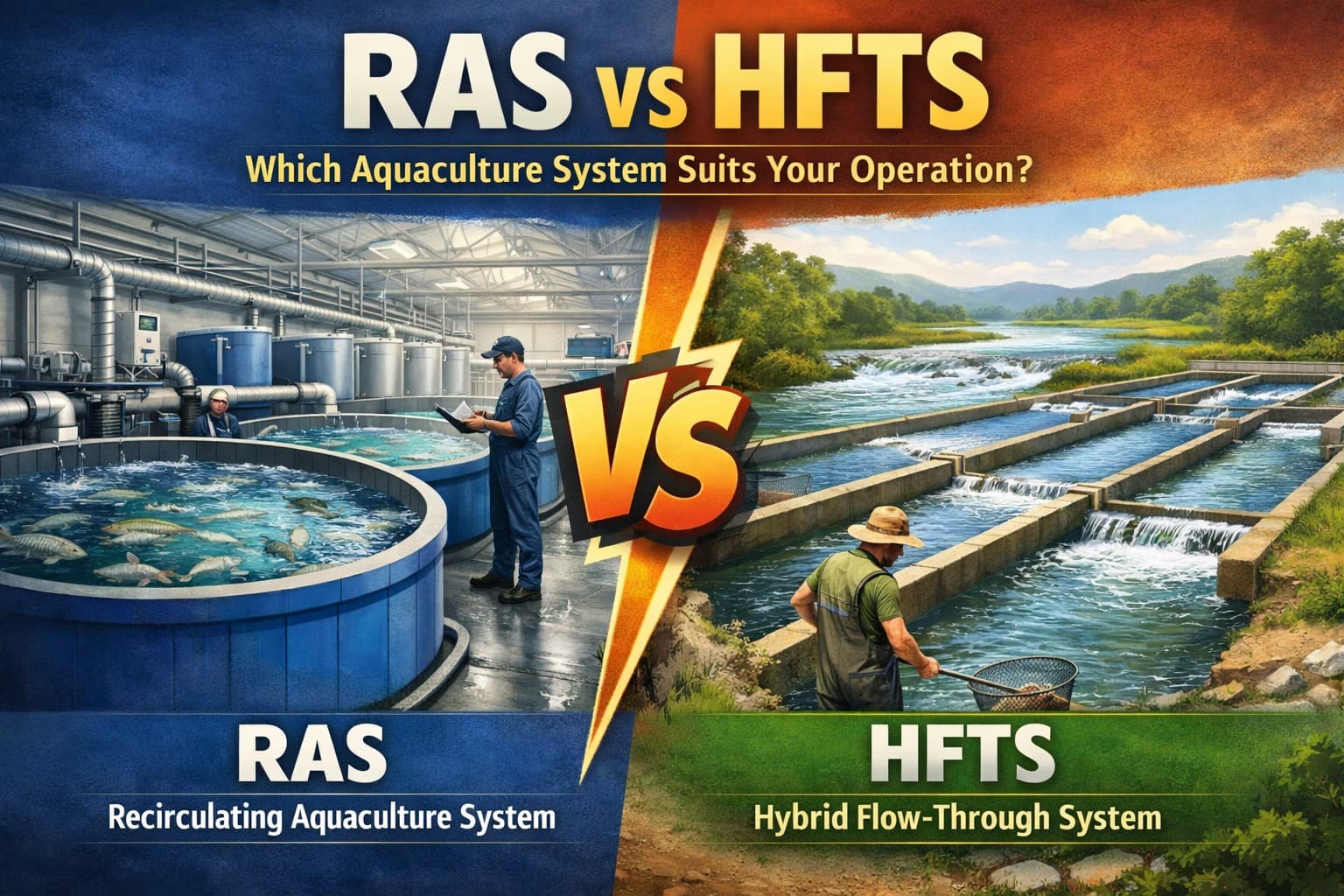
In Denmark, in the early 90s of the last century, they began to change the traditional flow-through trout farming system to a recirculating one, where, depending on the type of farm, the same water was used over and over again in‘volume from 70 to 95%.
What are the advantages of using recirculation systems when growing trout?
First, with the help of these systems, we significantly reduce emissions of harmful substances into the environment. With the help of settling tanks and micro-mesh filters, solid waste immediately falls into special lagoons for further processing and use as a valuable organic fertilizer. Dissolved nitrogenous substances are processed with the help of biological filters to relatively safe substances. For the final processing of water and its complete purification, the used water is fed into vegetative ponds (swamps), where it is restored to its original state with the help of biogenic factors and higher plants. After this treatment, the water can be safely fed into natural reservoirs.
Secondly, the amount of fresh water used to grow one kilogram of fish is drastically reduced. With a traditional system, this requires 50,000 liters, and
when using intensive farms, only 3,600 liters.

Thirdly, this system makes it possible to grow trout not only in the traditional areas for this (Carpathians), where there is a lot of flowing fresh water. Replenishment of water in the RAS requires the use of well water, which saves us from placing trout farms in areas with running water. For a 100-ton farm, you only need a water source of 15 l/s (this is the maximum use, the average is 5-7).
Fourthly, the use of this system allows maintaining optimal water parameters for fish growth, which has a positive effect on fish productivity. Many owners of flow-through farms in the Carpathians will confirm that they constantly have problems with water: in the summer it is very warm and there is little oxygen (the fish do not feed), after rains the water becomes very dirty (the fish cannot see the feed, which leads to loss of feed), in the winter the water cools down a lot (the fish also do not feed). Therefore, the terms of growing portioned trout from the 9-10 months we need are extended by at least two seasons.
These systems can be equipped with oxygen level controllers and automatically include additional aerators or oxygen saturation systems to achieve a satisfactory oxygen level in the system. A water temperature controller must also be installed in the system, which includes the supply of fresh cool water when the temperature rises. The optimal water temperature for growing trout is 16-17C. It is at these temperatures that the lowest ratio of feed utilization per unit of production is recorded. I think there is no need to write about automatic feeders taking into account the amount of biomass and the exact delivery of the daily feed rate.
The approximate cost of building a 100-ton farm is 250,000 Euros. At least the same amount of working capital is needed to grow 100 tons of fish. Such a farm can actually be launched in 6-8 months, and after 6-8 months we will receive the first harvest.
Licenses and control
One of the reasons for the low fish productivity of local trout farms is the lack of special knowledge. At the moment, anyone who has the means and desire to grow fish can try their hand at this type of aquaculture business. Yes, there are some difficulties with obtaining licenses for special water use, but the activity of fish breeding itself is not licensed.
In the same Denmark, for example, licenses are issued for annual feed consumption by a farm. It is clear that the fish productivity of the farm depends on this. If you have the ability to deal with the waste of a large amount of feed thanks to technology and special knowledge, then you get a license for more feed and can grow more fish on the same farm.
The continuous traditional farm is a constant source of pollution for the environment. It is especially dangerous when the farm owner does not understand safe fish farming technology. After all, the fish sometimes get sick (the water intake comes from the river, and wild fish live in it), so it has to be treated with chemicals. The problem of processing trout is that the water is flowing, and the time of exposure of the fish to ectoparasites is limited, so the drug is gradually introduced into the water. The excess of the drug falls directly into the river.
That is why it is important to subject all active trout farms in Ukraine to licensing. It is necessary to check whether the owners (farm staff) have the necessary knowledge of safe fish farming. This should become the main task of the Department of Aquaculture of the State Fisheries Service.
This will also allow us to establish control over the quality of products, their quantity, and help all market participants play by clearly established rules that apply absolutely to everyone.
So, active growth of aquaculture is possible in our country. 10,000 tons of trout grown per year is the absolute minimum that can easily be grown on our land. There are all the conditions for coming, investing and working here. The rules of the game must be jointly developed and agreed upon by all participants in this market. The state will only benefit from this. And citizens will eat delicious domestic fish.